Example: Context Injection
logging_context(context) enriches log records with invocation metadata from Azure Functions context. It is the recommended scoped API; inject_context() / restore_context() is the lower-level manual-token form of the same behavior.
Goal
Wrap the handler body in with logging_context(context): and observe invocation_id, function_name, trace_id, span_id, and cold_start in logs.
Baseline Handler
import azure.functions as func
from azure_functions_logging import JsonFormatter, get_logger, logging_context, setup_logging

setup_logging(functions_formatter=JsonFormatter())
logger = get_logger(__name__)

app = func.FunctionApp()


@app.route(route="hello")
def hello(req: func.HttpRequest, context: func.Context) -> func.HttpResponse:
    with logging_context(context):
        logger.info("request started")
        return func.HttpResponse("hello")
Fields Added by logging_context()
| Field | Source | Example |
|---|---|---|
invocation_id |
context.invocation_id |
9f87... |
function_name |
context.function_name |
hello |
trace_id |
context.trace_context.trace_parent (trace ID portion) |
7ed7... |
span_id |
context.trace_context.trace_parent (span ID portion) |
b7ad... |
cold_start |
internal first-call detection | true or false |
In Application Insights
After deploying the baseline handler and requesting /api/hello, query the traces table. In this deployment the structured JSON stays inside the message column, so we parse it with parse_json(message) (see the deployment query guide for the customDimensions-parsed variant).
traces
| where message startswith "{"
| extend p = parse_json(message)
| where tostring(p.function_name) == "hello"
| project timestamp, trace_id=tostring(p.trace_id), span_id=tostring(p.span_id), message=tostring(p.message)
| order by timestamp desc
| take 5
Result from a real deployed app:
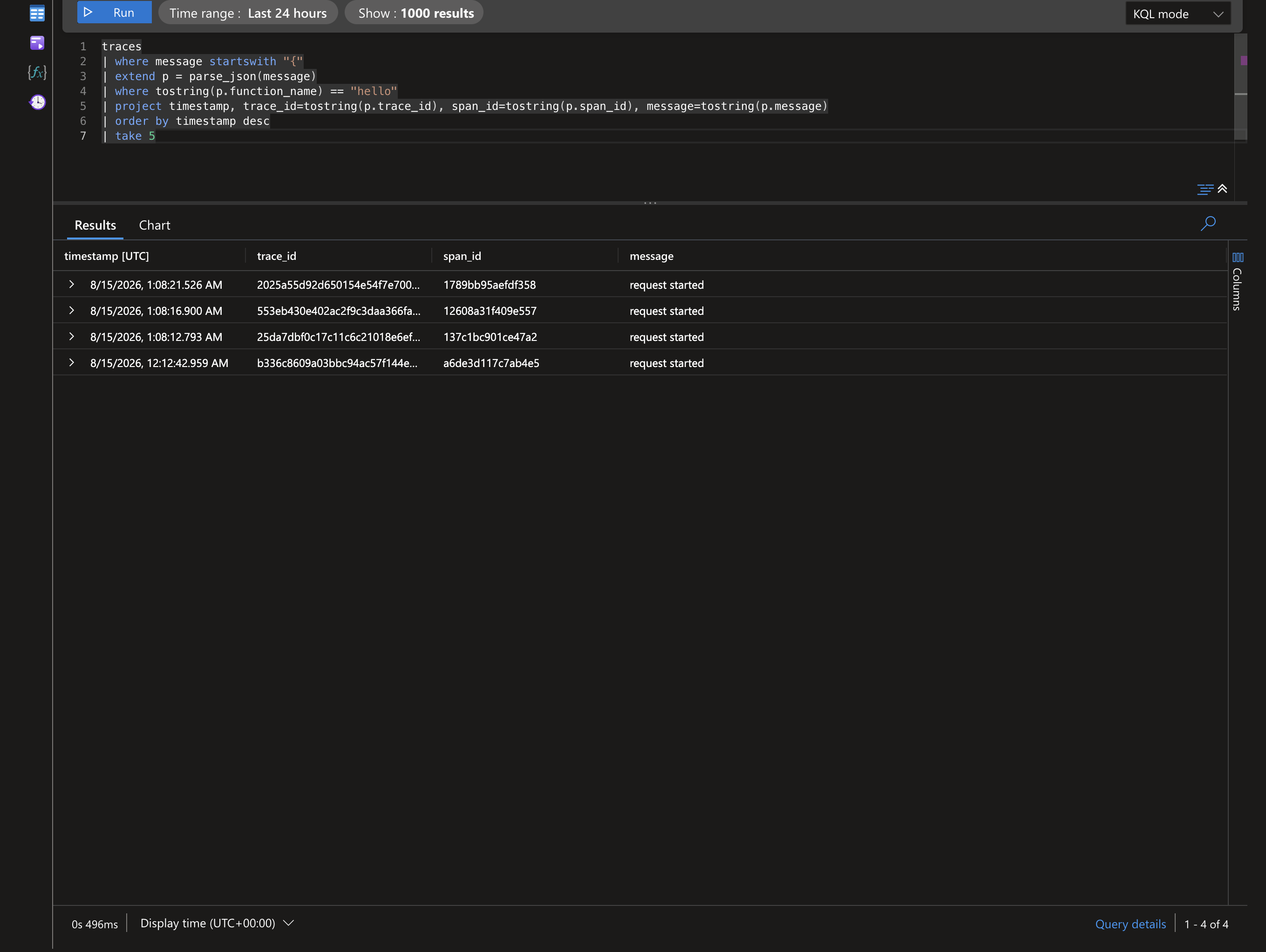
trace_id and span_id are populated only when the host supplies W3C trace context; otherwise they appear as null. All events emitted inside the same with logging_context(context): block share the same invocation_id.
If your pipeline parses the JSON into
customDimensionsinstead, dropparse_json(message)and readcustomDimensions.invocation_id/customDimensions.trace_iddirectly.
Why Open the Context Block Early
Open with logging_context(context): at the very top of each handler, before business logic:
- Every subsequent log call includes invocation metadata.
- Errors logged later in the pipeline still carry correlation fields.
- You avoid partial logs missing context.
Complete Handler with Error Path
import json
import azure.functions as func
from azure_functions_logging import JsonFormatter, get_logger, logging_context, setup_logging

setup_logging(functions_formatter=JsonFormatter())
logger = get_logger("payments.handler")

app = func.FunctionApp()


@app.route(route="payments")
def payments(req: func.HttpRequest, context: func.Context) -> func.HttpResponse:
    with logging_context(context):
        logger.info("payments request received", method=req.method)

        try:
            body = req.get_json()
            amount = body.get("amount")
            logger.info("validating payload", amount=amount)

            if amount is None:
                logger.warning("missing amount field")
                return func.HttpResponse("invalid payload", status_code=400)

            logger.info("payment accepted", amount=amount)
            return func.HttpResponse(json.dumps({"status": "ok"}), mimetype="application/json")
        except Exception:
            logger.exception("payments handler failed")
            return func.HttpResponse("internal error", status_code=500)
Behavior Outside Azure
inject_context() is safe outside Azure.
If your object does not contain expected attributes, fields are set to None and execution continues.
from azure_functions_logging import get_logger, inject_context, setup_logging

class DummyContext:
    invocation_id = "local-1"
    function_name = "dummy"


setup_logging(format="json")
logger = get_logger("local")

inject_context(DummyContext())
logger.info("local simulation")
Recommended Request Flow
For each invocation:
- Open
with logging_context(context):at the top of the handler. - Create optional bound logger for request metadata.
- Emit lifecycle logs for start, decision points, and completion.
- Use
logger.exception()in failure paths.
Pairing with bind()
request_logger = logger.bind(route="/payments", method=req.method)
request_logger.info("processing started")
This combines invocation metadata (context injection) with request metadata (binding).
What to Verify in Output
invocation_idpresent for every event in invocation.function_namematches actual function.trace_idconsistent across related events.span_idconsistent with the W3C parent/span portion when trace context is present.cold_starttrue only on first invocation per process.
Common Mistakes
- Opening
with logging_context(context):after first logs are already emitted. - Assuming
trace_idis present when trace context is absent. - Forgetting the
with logging_context(context):wrapper in some handlers, causing partial correlation.
Tip
If you use decorators or middleware-like wrappers, open with logging_context(context): in the outermost request entrypoint to guarantee consistency.