Example: Context Binding
FunctionLogger.bind() attaches persistent key-value context to a logger and returns a new logger instance.
Goal
Use bind() for request-scoped metadata, chain bindings safely, and clear bound context when needed.
Baseline Pattern
from azure_functions_logging import get_logger, setup_logging

setup_logging(format="json")
logger = get_logger(__name__)

request_logger = logger.bind(request_id="req-1", tenant_id="tenant-a")
request_logger.info("request started")
request_logger.info("request completed")
Both log lines include request_id and tenant_id.
Immutability Guarantee
bind() does not mutate the original logger.
Result:
baseevents do not includeuser_id.boundevents includeuser_id.
This behavior helps avoid accidental context leaks.
Chaining Bind Calls
base = get_logger("checkout")
l1 = base.bind(request_id="r-100")
l2 = l1.bind(user_id="u-900")
l3 = l2.bind(cart_id="c-55")

l3.info("checkout started")
l3 contains all merged keys: request_id, user_id, cart_id.
Clearing Context
Use clear_context() on a bound logger to remove accumulated binding on that instance.
bound = logger.bind(user_id="u-1", operation="refund")
bound.info("before clear")

bound.clear_context()
bound.info("after clear")
After clear_context(), bound fields from that instance are removed.
Azure Functions Request Pattern
import azure.functions as func
from azure_functions_logging import JsonFormatter, get_logger, logging_context, setup_logging

setup_logging(functions_formatter=JsonFormatter())
logger = get_logger("orders")

app = func.FunctionApp()


@app.route(route="orders/{order_id}")
def get_order(req: func.HttpRequest, context: func.Context) -> func.HttpResponse:
    with logging_context(context):
        order_id = req.route_params.get("order_id")
        request_logger = logger.bind(order_id=order_id, method=req.method)

        request_logger.info("lookup started")
        request_logger.info("lookup completed")
        return func.HttpResponse("ok")
This combines:
- Global invocation fields from
logging_context(context). - Per-request keys from
bind().
In Application Insights
After deploying and requesting /api/orders/o-42, query the traces table. In this deployment the structured JSON stays inside the message column, so we parse it with parse_json(message) — bound keys land under extra.* alongside the injected invocation fields (see the deployment query guide for the customDimensions-parsed variant).
traces
| where message startswith "{"
| extend p = parse_json(message)
| where tostring(p.function_name) == "get_order"
| project timestamp, order_id=tostring(p.extra.order_id), method=tostring(p.extra.method), message=tostring(p.message)
| order by timestamp desc
| take 6
Result from a real deployed app — both lifecycle events share the same bound order_id / method:
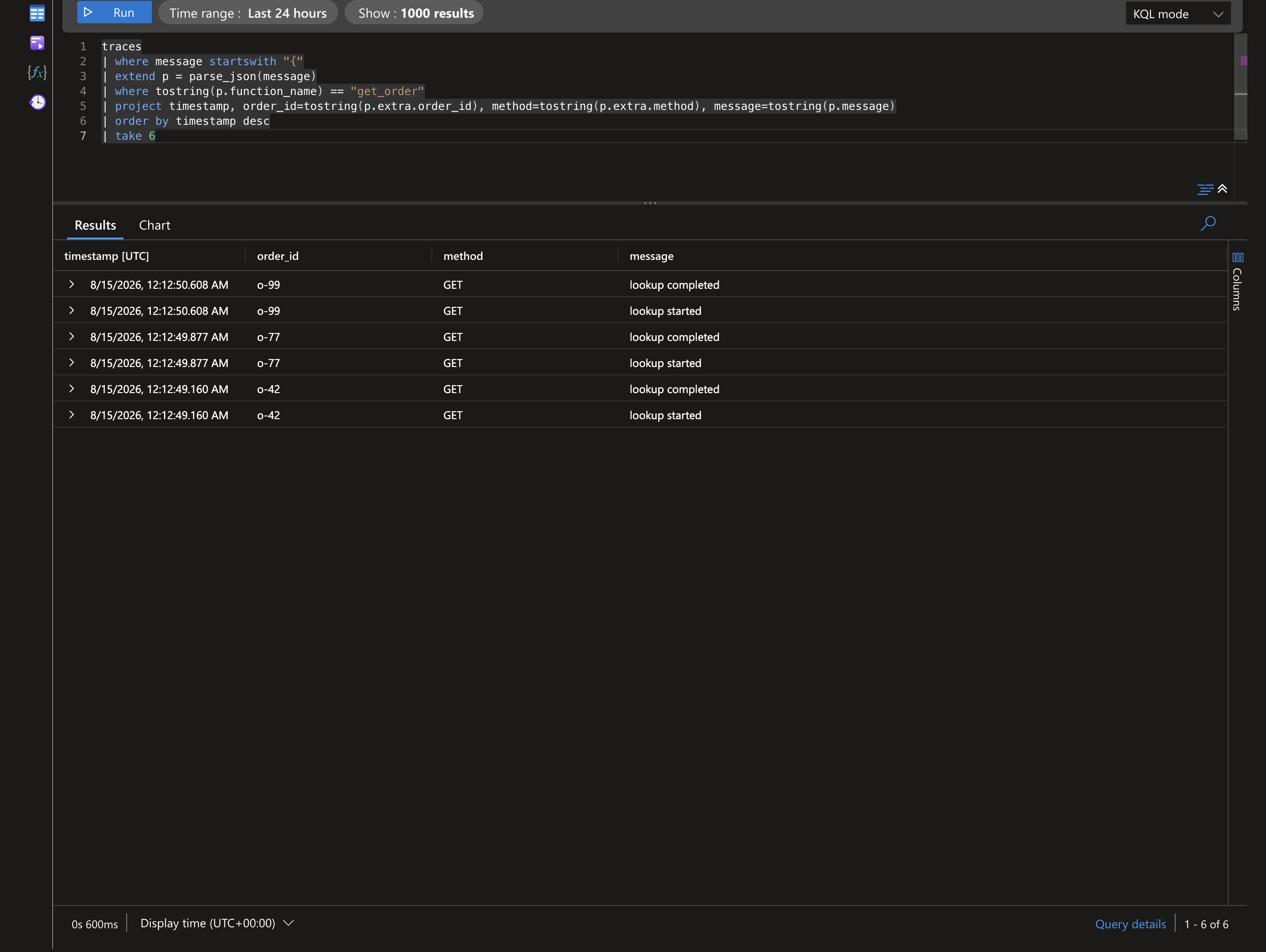
The bound order_id lets you slice every log for one order in a single query, without threading it through each call.
If your pipeline parses the JSON into
customDimensionsinstead, dropparse_json(message)and readcustomDimensions.order_iddirectly.
Recommended Binding Dimensions
Good binding keys are stable per request scope:
request_idtenant_iduser_idoperationroute
Avoid high-cardinality noisy keys unless required for diagnostics.
Binding vs Per-Call Extra
Use bind() when a key should appear on many logs in the same scope.
Use per-call kwargs when data is specific to a single event.
request_logger = logger.bind(request_id="r-1", tenant_id="t-1")
request_logger.info("payment authorized", amount=19.9, currency="USD")
Safety Notes
- Do not keep request-specific bound loggers as global singletons.
- Create bound loggers inside invocation scope.
- Prefer immutable bind chains over mutable shared state.
Warning
Reusing one globally bound logger for unrelated requests can create misleading correlation data.
Mini End-to-End Flow
def process_checkout(base_logger, request_id, user_id):
    log = base_logger.bind(request_id=request_id, user_id=user_id, operation="checkout")
    log.info("step 1: validate cart")
    log.info("step 2: authorize payment")
    log.info("step 3: create order")
All steps share the same contextual dimensions.