Webhook Receiver Example
This is the representative example showing the core @openapi workflow.
It accepts inbound webhook events with HMAC-SHA256 signature verification
and returns 202 Accepted.
Source: examples/webhook_receiver/function_app.py
What this example includes
| Method | Route | Purpose |
|---|---|---|
POST |
/api/webhooks/orders |
Receive order webhook |
GET |
/api/openapi.json |
OpenAPI JSON |
GET |
/api/openapi.yaml |
OpenAPI YAML |
GET |
/api/docs |
Swagger UI |
Features demonstrated
@openapi()withsummary,description,tagsrequest_modelandresponse_modelfor Pydantic schema generationresponsedict for documenting multiple status codes (202, 400, 401, 409)get_openapi_json(),get_openapi_yaml()render_swagger_ui()
Data models
class WebhookEvent(BaseModel):
    event_type: str = Field(..., description="Event type, e.g. 'order.completed'.")
    source: str = Field(..., description="Origin system, e.g. 'shopify'.")
    occurred_at: str = Field(..., description="ISO-8601 timestamp of event occurrence.")
    data: dict[str, Any] = Field(default_factory=dict, description="Arbitrary event payload.")


class WebhookAcceptedResponse(BaseModel):
    delivery_id: str = Field(..., description="Unique delivery identifier.")
    status: str = Field(default="accepted", description="Processing status.")
    received_at: str = Field(..., description="ISO-8601 timestamp of receipt.")
How the docs are configured
@openapi(
    route="/api/webhooks/orders",
    method="post",
    summary="Receive order webhook",
    description=(
        "Accepts an inbound webhook event for asynchronous processing.\n\n"
        "If `WEBHOOK_SECRET` is set, the `X-Signature` header is verified "
        "using HMAC-SHA256 (bound to `X-Webhook-Timestamp`) before the "
        "payload is accepted. Stale timestamps (>5 min) are rejected.\n\n"
        "Duplicate deliveries are rejected via the `X-Delivery-Id` header."
    ),
    tags=["webhooks"],
    request_model=WebhookEvent,
    response_model=WebhookAcceptedResponse,
    response={
        202: {"description": "Webhook accepted for processing"},
        400: {"description": "Invalid request payload"},
        401: {"description": "Invalid webhook signature or expired timestamp"},
        409: {"description": "Duplicate delivery (replay)"},
    },
    )
@app.route(route="webhooks/orders", methods=["POST"], auth_level=func.AuthLevel.ANONYMOUS)
def receive_order_webhook(req: func.HttpRequest) -> func.HttpResponse:
    ...
Run locally
The examples/ directories contain source modules, not standalone Function App projects.
To run locally, copy the example into a project directory with the required host.json:
mkdir -p my-webhook-app
cp examples/webhook_receiver/function_app.py my-webhook-app/
cat > my-webhook-app/host.json << 'EOF'
{
  "version": "2.0",
  "extensionBundle": {
    "id": "Microsoft.Azure.Functions.ExtensionBundle",
    "version": "[4.*, 5.0.0)"
  }
}
EOF

cd my-webhook-app
python -m venv .venv
source .venv/bin/activate
pip install azure-functions azure-functions-openapi pydantic
func start
Test with curl
Success case
curl -X POST "http://localhost:7071/api/webhooks/orders" \
  -H "Content-Type: application/json" \
  -d '{"event_type":"order.completed","source":"shopify","occurred_at":"2026-04-12T00:00:00+00:00","data":{"order_id":"12345"}}'
Expected output (status 202):
With HMAC signature
Set the WEBHOOK_SECRET environment variable, then include the signature headers:
curl -X POST "http://localhost:7071/api/webhooks/orders" \
  -H "Content-Type: application/json" \
  -H "X-Signature: sha256=<computed_hmac>" \
  -H "X-Webhook-Timestamp: 2026-04-12T00:00:00+00:00" \
  -H "X-Delivery-Id: dlv-unique-001" \
  -d '{"event_type":"order.completed","source":"shopify","occurred_at":"2026-04-12T00:00:00+00:00"}'
Error case — missing required fields
curl -X POST "http://localhost:7071/api/webhooks/orders" \
  -H "Content-Type: application/json" \
  -d '{"event_type":"order.completed"}'
Expected output (status 400):
Inspect generated spec
JSON:
YAML:
You should see one path for /api/webhooks/orders with:
- tag
webhooks WebhookEventrequest schemaWebhookAcceptedResponseresponse schema202,400,401,409response codes
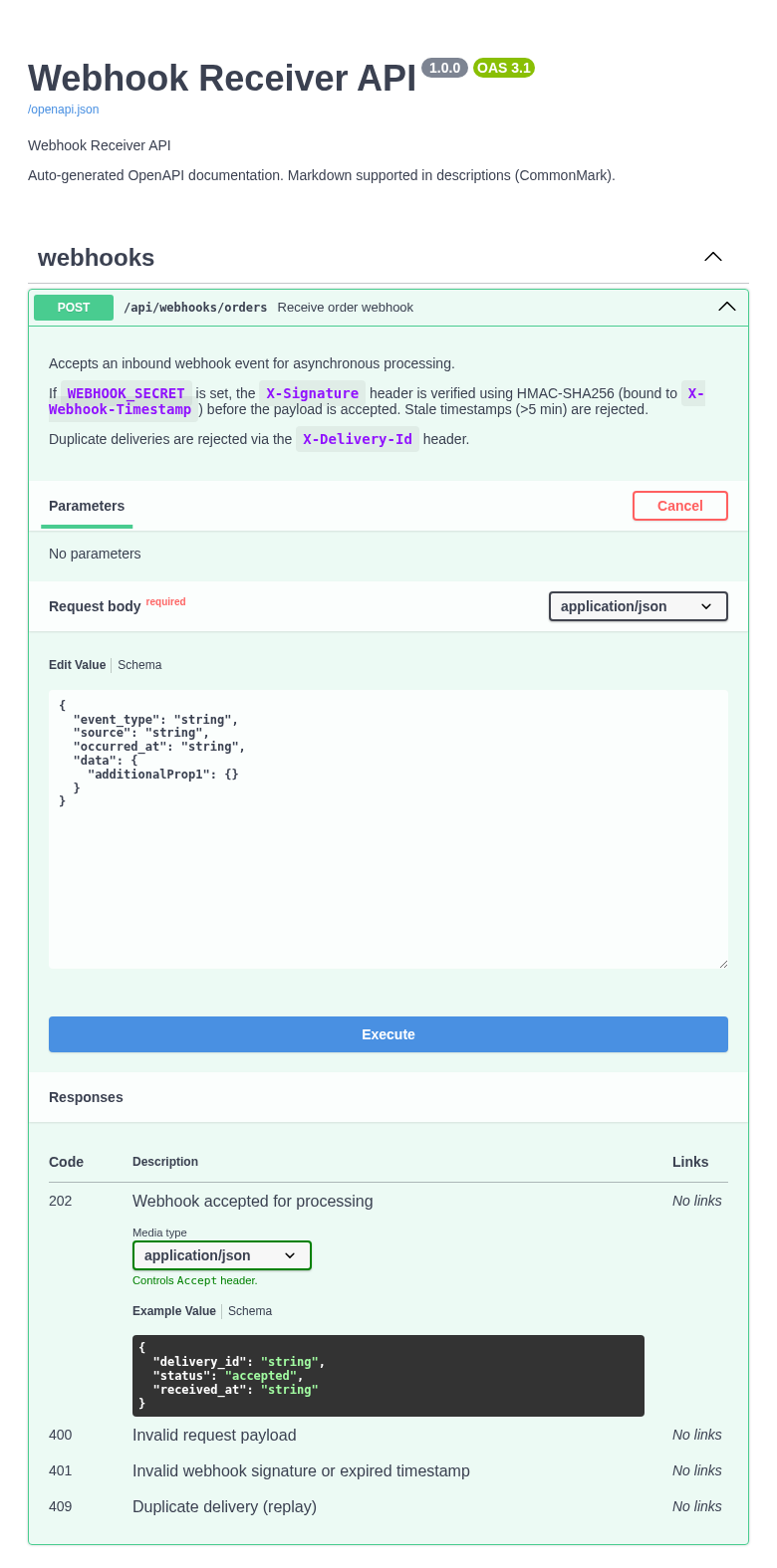
Open Swagger UI
Open http://localhost:7071/api/docs in your browser.
Expected behavior:
- the
receive_order_webhookoperation appears - request body editor shows
WebhookEventfields Try it outsends request to your local function app
Production takeaways
- Always verify webhook signatures when accepting external events
- Use delivery ID deduplication to handle retries safely
- Reject stale timestamps to prevent replay attacks
- Return
202 Accepted(not200 OK) for async processing
Next example
See Report Jobs Example for a multi-endpoint API with Bearer auth and async job polling.