Notification Request Example
This is the integration example showing how to stack @openapi and @validate_http
on the same handler. Pydantic models are shared between both decorators so the
OpenAPI spec and runtime validation stay synchronized.
Source: examples/notification_request/function_app.py
What this example includes
| Method | Route | Purpose |
|---|---|---|
POST |
/api/notifications/email |
Send email notification |
GET |
/api/notifications/status |
Get notification delivery status |
GET |
/api/openapi.json |
OpenAPI JSON |
GET |
/api/openapi.yaml |
OpenAPI YAML |
GET |
/api/docs |
Swagger UI |
Features demonstrated
@openapiand@validate_httpstacked on the same handlerrequests=parameter for request model (unified param)response_model=for response schemaresponsedict for multi-status documentation (202, 404, 422)- Shared Pydantic models between OpenAPI and validation decorators
Data models
class EmailNotificationRequest(BaseModel):
    to: list[str] = Field(..., min_length=1, description="Recipient email addresses.")
    subject: str = Field(..., min_length=1, max_length=200, description="Email subject line.")
    body_text: str = Field(..., description="Plain-text email body.")
    body_html: str | None = Field(default=None, description="Optional HTML email body.")
    priority: str = Field(default="normal", description="Priority: low, normal, high.")


class NotificationAcceptedResponse(BaseModel):
    notification_id: str = Field(..., description="Unique notification identifier.")
    status: str = Field(default="queued", description="Processing status.")
    queued_at: str = Field(..., description="ISO-8601 timestamp.")


class NotificationStatusQuery(BaseModel):
    notification_id: str = Field(..., description="Notification ID to look up.")


class NotificationStatusResponse(BaseModel):
    notification_id: str
    status: str = Field(..., description="One of: queued, sending, delivered, failed.")
    delivered_at: str | None = Field(default=None, description="Delivery timestamp.")
How the docs are configured
Both decorators share the same Pydantic model:
@openapi(
    route="/api/notifications/email",
    method="post",
    summary="Send email notification",
    description="Validate and queue an email notification for delivery.",
    tags=["notifications"],
    requests=EmailNotificationRequest,
    response_model=NotificationAcceptedResponse,
    response={
        202: {"description": "Notification queued for delivery"},
        422: {"description": "Validation error"},
    },
    )
@app.route(route="notifications/email", methods=["POST"], auth_level=func.AuthLevel.ANONYMOUS)
@validate_http(body=EmailNotificationRequest, response_model=NotificationAcceptedResponse)
def send_notification(
    req: func.HttpRequest, body: EmailNotificationRequest
) -> func.HttpResponse:
    ...
The status endpoint uses query parameter validation:
@openapi(
    route="/api/notifications/status",
    method="get",
    summary="Get notification status",
    description="Look up the delivery status of a previously queued notification.",
    tags=["notifications"],
    parameters=[
        {
            "name": "notification_id",
            "in": "query",
            "required": True,
            "description": "Notification ID returned from the send endpoint.",
            "schema": {"type": "string"},
        }
    ],
    response_model=NotificationStatusResponse,
    response={
        200: {"description": "Notification status"},
        404: {"description": "Notification not found"},
    },
)
@validate_http(query=NotificationStatusQuery, response_model=NotificationStatusResponse)
def get_notification_status(
    req: func.HttpRequest, query: NotificationStatusQuery
) -> NotificationStatusResponse | func.HttpResponse:
    ...
Run locally
The examples/ directories contain source modules, not standalone Function App projects.
To run locally, copy the example into a project directory with the required host.json:
mkdir -p my-notification-app
cp examples/notification_request/function_app.py my-notification-app/
cat > my-notification-app/host.json << 'EOF'
{
  "version": "2.0",
  "extensionBundle": {
    "id": "Microsoft.Azure.Functions.ExtensionBundle",
    "version": "[4.*, 5.0.0)"
  }
}
EOF

cd my-notification-app
python -m venv .venv
source .venv/bin/activate
pip install azure-functions azure-functions-openapi azure-functions-validation pydantic
func start
Test with curl
1) Send notification (valid)
curl -X POST "http://localhost:7071/api/notifications/email" \
  -H "Content-Type: application/json" \
  -d '{"to":["user@example.com"],"subject":"Test","body_text":"Hello from the API"}'
Expected output (status 202):
2) Send notification (invalid body)
curl -X POST "http://localhost:7071/api/notifications/email" \
  -H "Content-Type: application/json" \
  -d '{"to":[],"subject":""}'
Expected behavior:
- request fails validation
- response status
422with validation error details
3) Get notification status
Expected output:
4) Get unknown notification
Expected status:
Inspect generated spec
You should see:
- two operations under
notificationstag EmailNotificationRequestandNotificationAcceptedResponseschemas- query parameter
notification_idon the status endpoint
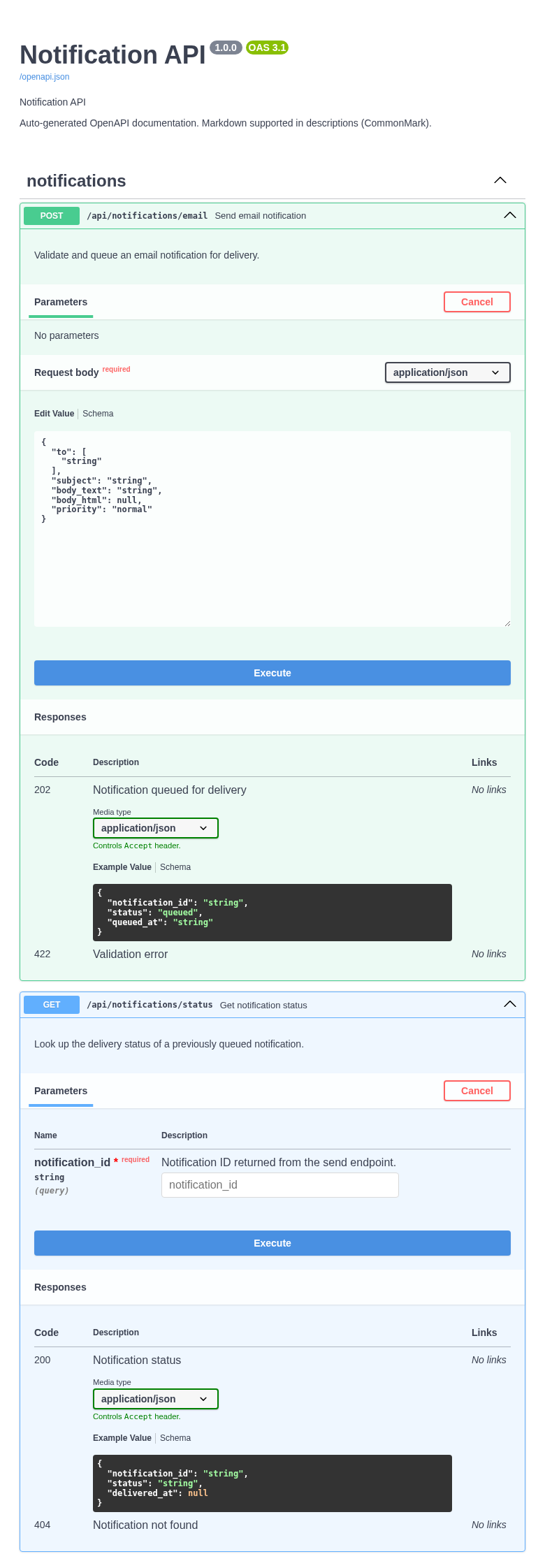
Open Swagger UI
Open http://localhost:7071/api/docs in your browser.
Expected behavior:
notificationstag groups both operations- request body editor for
POST /api/notifications/email - query parameter input for
notification_id
Production takeaways
- Stack
@openapiand@validate_httpon the same handler for synchronized docs and validation - Use shared Pydantic models to prevent schema drift between spec and runtime
- Return explicit
func.HttpResponsewithstatus_code=202for async operations (bypasses@validate_httpdefault 200) - Add
422response documentation for validation error paths
Next example
See Partner Import Bridge Example for auto-generating OpenAPI docs from @validate_http without @openapi.