Report Jobs Example
This is the complex example demonstrating a multi-endpoint API with Bearer token authentication and an async job pattern: submit a report, poll its status, and download the result.
Source: examples/report_jobs/function_app.py
What this example includes
| Method | Route | Purpose |
|---|---|---|
POST |
/api/reports |
Submit a report job |
GET |
/api/reports/{job_id}/status |
Poll job status |
GET |
/api/reports/{job_id}/download |
Download completed report |
GET |
/api/openapi.json |
OpenAPI JSON |
GET |
/api/openapi.yaml |
OpenAPI YAML (3.1) |
GET |
/api/docs |
Swagger UI |
Features demonstrated
@openapi()withsecurityandsecurity_scheme(Bearer token)- Path parameters (
{job_id}) generate_openapi_spec()withOPENAPI_VERSION_3_1render_swagger_ui()withcustom_cspandenable_client_logging=Truerequest_modelandresponse_model- Multiple response codes per endpoint (200, 202, 400, 401, 404)
Data models
class ReportFormat(str, Enum):
    csv = "csv"
    pdf = "pdf"
    xlsx = "xlsx"


class ReportRequest(BaseModel):
    report_type: str = Field(..., description="Report type, e.g. 'monthly_sales'.")
    date_from: str = Field(..., description="Start date (ISO-8601).")
    date_to: str = Field(..., description="End date (ISO-8601).")
    format: ReportFormat = Field(default=ReportFormat.csv, description="Output format.")
    filters: dict[str, Any] = Field(default_factory=dict, description="Optional filters.")


class ReportJobResponse(BaseModel):
    job_id: str = Field(..., description="Unique job identifier.")
    status: str = Field(default="queued", description="Job status.")
    created_at: str = Field(..., description="ISO-8601 timestamp.")


class ReportStatusResponse(BaseModel):
    job_id: str
    status: str = Field(..., description="One of: queued, processing, completed, failed.")
    progress_pct: int = Field(default=0, description="Progress percentage (0-100).")
    download_url: str | None = Field(default=None, description="Available when status=completed.")
    error: str | None = Field(default=None, description="Error message when status=failed.")
How the docs are configured
Security is declared once and reused across all endpoints:
_BEARER_SCHEME = {
    "BearerAuth": {
        "type": "http",
        "scheme": "bearer",
        "bearerFormat": "JWT",
        "description": "API key or JWT token",
    }
}
_BEARER_SECURITY = [{"BearerAuth": []}]


@openapi(
    route="/api/reports",
    method="post",
    summary="Submit a report job",
    description="Queue a new report generation job. Returns a job ID for status polling.",
    tags=["reports"],
    request_model=ReportRequest,
    response_model=ReportJobResponse,
    response={
        202: {"description": "Report job queued"},
        400: {"description": "Invalid request"},
        401: {"description": "Unauthorized"},
    },
    security=_BEARER_SECURITY,
    security_scheme=_BEARER_SCHEME,
    )
@app.route(route="reports", methods=["POST"], auth_level=func.AuthLevel.ANONYMOUS)
def submit_report(req: func.HttpRequest) -> func.HttpResponse:
    ...
The OpenAPI YAML route uses generate_openapi_spec() with OPENAPI_VERSION_3_1:
from azure_functions_openapi import OPENAPI_VERSION_3_1, generate_openapi_spec

spec = generate_openapi_spec(
    title="Report Jobs API",
    version="1.0.0",
    openapi_version=OPENAPI_VERSION_3_1,
)
The Swagger UI route uses custom_csp and enable_client_logging:
render_swagger_ui(
    title="Report Jobs API",
    custom_csp=(
        "default-src 'self'; "
        "script-src 'self' 'unsafe-inline' https://cdn.jsdelivr.net; "
        "style-src 'self' 'unsafe-inline' https://cdn.jsdelivr.net; "
        "img-src 'self' data: https:; "
        "font-src 'self' https://cdn.jsdelivr.net; "
        "connect-src 'self'"
    ),
    enable_client_logging=True,
)
Run locally
The examples/ directories contain source modules, not standalone Function App projects.
To run locally, copy the example into a project directory with the required host.json:
mkdir -p my-report-app
cp examples/report_jobs/function_app.py my-report-app/
cat > my-report-app/host.json << 'EOF'
{
  "version": "2.0",
  "extensionBundle": {
    "id": "Microsoft.Azure.Functions.ExtensionBundle",
    "version": "[4.*, 5.0.0)"
  }
}
EOF

cd my-report-app
python -m venv .venv
source .venv/bin/activate
pip install azure-functions azure-functions-openapi pydantic pyyaml
func start
Test with curl
1) Submit a report job
curl -X POST "http://localhost:7071/api/reports" \
  -H "Content-Type: application/json" \
  -H "Authorization: Bearer test-token-123" \
  -d '{"report_type":"monthly_sales","date_from":"2026-01-01","date_to":"2026-01-31","format":"csv"}'
Expected output (status 202):
2) Poll status
curl "http://localhost:7071/api/reports/rpt_abc123def456/status" \
  -H "Authorization: Bearer test-token-123"
Expected output:
3) Download (when completed)
curl "http://localhost:7071/api/reports/rpt_abc123def456/download" \
  -H "Authorization: Bearer test-token-123"
4) Unauthorized request
curl -X POST "http://localhost:7071/api/reports" \
  -H "Content-Type: application/json" \
  -d '{"report_type":"monthly_sales","date_from":"2026-01-01","date_to":"2026-01-31"}'
Expected output (status 401):
Inspect generated spec
You should see:
- three paths under
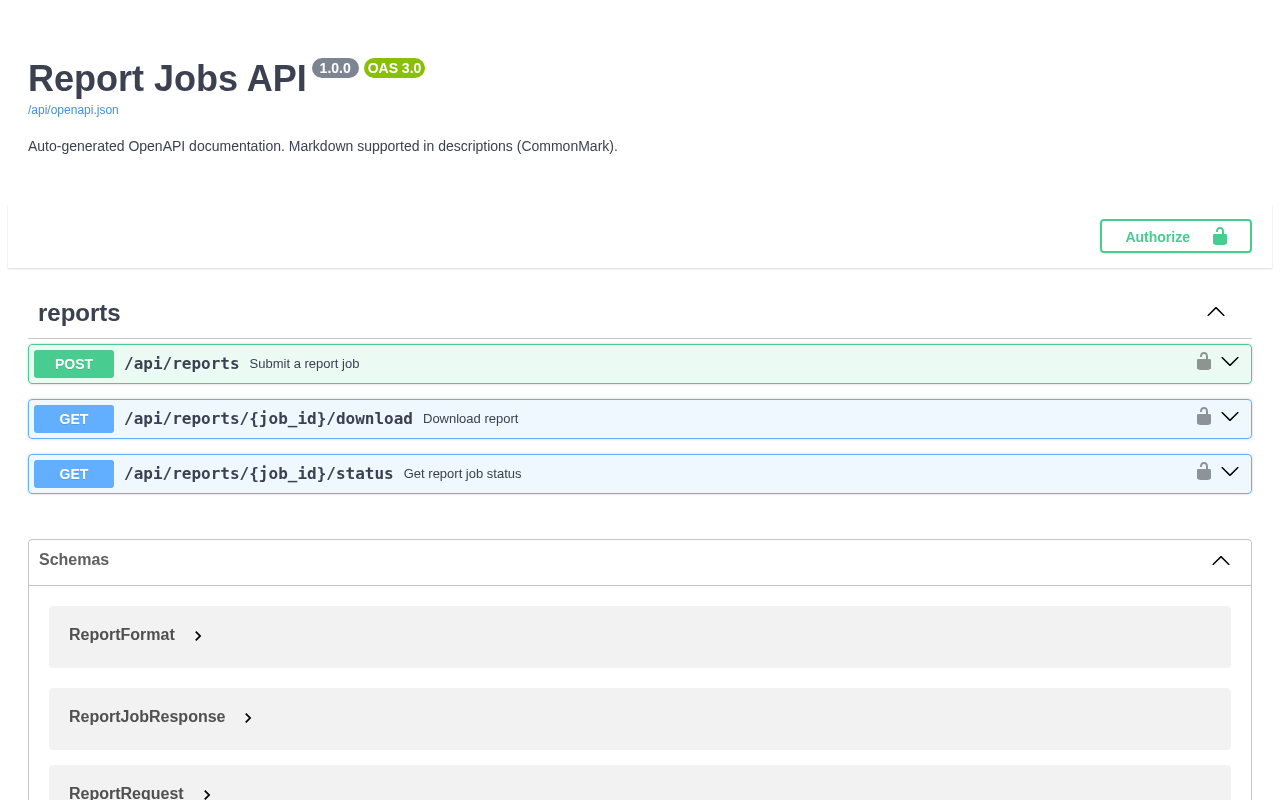
reportstag securitySchemes.BearerAuthincomponentssecurityrequirement on all three operationsReportRequest,ReportJobResponse,ReportStatusResponseschemas
Open Swagger UI
Open http://localhost:7071/api/docs in your browser.
Expected behavior:
- all
reportsoperations grouped under one tag Authorizebutton for Bearer token input- request body editor for
POST /api/reports - path parameter field for
{job_id}
Production takeaways
- Use
security_schemeto declare auth requirements in the generated spec - Validate tokens in handler code (the spec only documents the requirement)
- Return
202for async jobs and provide a status polling endpoint - Use
generate_openapi_spec()when you need fine-grained control over spec output
Next example
See Notification Request Example for combining @openapi with @validate_http on the same handler.