Usage Guide
This guide shows how to document Azure Functions Python v2 HTTP handlers with azure-functions-openapi using production-ready patterns.
Before you start
- Install package:
pip install azure-functions-openapi - Use Azure Functions Python v2 programming model (
func.FunctionApp) - Ensure your app has explicit routes for OpenAPI JSON/YAML and Swagger UI
See Installation and Getting Started first.
For configurable URL prefixes (custom or empty host.json routePrefix),
see Route Prefix.
End-to-end baseline
import json

import azure.functions as func
from pydantic import BaseModel

from azure_functions_openapi import get_openapi_json, get_openapi_yaml, openapi, render_swagger_ui

app = func.FunctionApp()


class EchoRequest(BaseModel):
    message: str


class EchoResponse(BaseModel):
    echoed: str


@app.function_name(name="echo")
@openapi(
    summary="Echo message",
    description="Returns the same message received in the request body.",
    tags=["Echo"],
    operation_id="echoMessage",
    route="/api/echo",
    method="post",
    requests=EchoRequest,
    responses={
        200: {
            "description": "Echoed message",
            "content": {"application/json": {"schema": EchoResponse}},
        },
        400: {"description": "Invalid body"},
    },
    )
@app.route(route="echo", methods=["POST"], auth_level=func.AuthLevel.ANONYMOUS)
def echo(req: func.HttpRequest) -> func.HttpResponse:
    try:
        data = EchoRequest.model_validate_json(req.get_body())
    except Exception:
        return func.HttpResponse("Invalid body", status_code=400)

    return func.HttpResponse(
        json.dumps({"echoed": data.message}),
        mimetype="application/json",
        status_code=200,
    )


@app.function_name(name="openapi_json")
@app.route(route="openapi.json", methods=["GET"], auth_level=func.AuthLevel.ANONYMOUS)
def openapi_json(req: func.HttpRequest) -> func.HttpResponse:
    return func.HttpResponse(
        get_openapi_json(title="Echo API", version="1.0.0"),
        mimetype="application/json",
    )


@app.function_name(name="openapi_yaml")
@app.route(route="openapi.yaml", methods=["GET"], auth_level=func.AuthLevel.ANONYMOUS)
def openapi_yaml(req: func.HttpRequest) -> func.HttpResponse:
    return func.HttpResponse(
        get_openapi_yaml(title="Echo API", version="1.0.0"),
        mimetype="application/x-yaml",
    )


@app.function_name(name="swagger_ui")
@app.route(route="docs", methods=["GET"], auth_level=func.AuthLevel.ANONYMOUS)
def swagger_ui(req: func.HttpRequest) -> func.HttpResponse:
    return render_swagger_ui(title="Echo API Docs", openapi_url="/api/openapi.json")
Understanding @openapi
@openapi captures metadata and stores it in a registry consumed by spec generators.
Minimal metadata
Typical metadata
@openapi(
    summary="Get order",
    description="Fetch one order by ID.",
    tags=["Orders"],
    operation_id="getOrder",
    route="/api/orders/{order_id}",
    method="get",
)
Note
If tags is omitted, the library defaults to ['default'].
Request and response schema styles
@openapi exposes two unified schema parameters — requests and
responses — each of which accepts either a Pydantic model class or a raw
schema dict. Prefer these over the older discrete parameters.
Discrete parameters were removed from @openapi (issue #285)
request_model / request_body / response_model / response were
removed from @openapi; use requests and responses instead. The
discrete parameters remain available on register_openapi_metadata(). See
the migration guide for before/after recipes
(every discrete case now migrates).
Style A: Pydantic models
Best when you already validate payloads with Pydantic. Pass the model class
directly to requests / responses.
class CreateOrderRequest(BaseModel):
    sku: str
    quantity: int


class OrderResponse(BaseModel):
    id: int
    sku: str
    quantity: int


@openapi(
    summary="Create order",
    method="post",
    requests=CreateOrderRequest,
    responses=OrderResponse,
)
responses=OrderResponse derives the 200 response schema from the model.
Style B: Raw schema dictionaries
Best when you do not use Pydantic. Pass a raw requestBody schema dict to
requests and a manual responses map (keyed by status code) to responses.
@openapi(
    summary="Create order",
    method="post",
    requests={
        "type": "object",
        "properties": {
            "sku": {"type": "string"},
            "quantity": {"type": "integer", "minimum": 1},
        },
        "required": ["sku", "quantity"],
    },
    responses={
        201: {
            "description": "Created",
            "content": {
                "application/json": {
                    "schema": {
                        "type": "object",
                        "properties": {"id": {"type": "integer"}},
                    }
                }
            },
        }
    },
)
Note
requests decides its meaning by type: a BaseModel subclass is treated
like the old request_model, and a dict is treated like the old
request_body. responses behaves the same way.
Optional request bodies
Set request_body_required=False when the request body is optional (it
defaults to True):
@openapi(
    summary="Partial update",
    method="patch",
    requests=PatchOrderRequest,
    request_body_required=False,
)
Migrating to requests / responses
Old (removed from @openapi) |
New |
|---|---|
request_model=Model |
requests=Model |
request_body={...} |
requests={...} |
response_model=Model |
responses=Model |
response={201: {...}} |
responses={201: {...}} |
A typed success body plus extra status codes now migrates too
responses= accepts either a model (typed 200 schema) or a
per-status map — and a value inside that map may itself be a model. So a
typed success body combined with additional status codes (formerly the
response_model=Model + response={...} pair) is now expressible as a
single map, e.g. responses={202: AcceptedModel, 422: {"description": ...}}
(unblocked by issue #410 / #418). See the migration
guide for full before/after recipes and the
removal policy.
Inferred metadata (return type & docstring)
@openapi can infer parts of the operation from what the handler already
declares, so you can shrink the decorator toward minimal. Inference is always
gap-fill-only, lowest-precedence, and failure-silent: it never overrides an
explicit value, never raises on unresolved annotations, and applies at both
decorator-time (@openapi) and scan-time (a bare @app.route with no
@openapi).
Precedence (highest to lowest):
- Explicit
@openapiarguments (e.g.responses=,summary=). - Validation / enrichment metadata (e.g. from
@validate_http). - Inference (return type, docstring).
Return-type inference
When you supply no explicit responses=, the handler's return annotation infers
the 200 response. This inference is on by default — a return type is a
structural declaration, not free-form prose, so publishing it needs no separate
consent:
@openapi(summary="Get order")
@app.route(route="orders/{id}", methods=["GET"])
def get_order(req: func.HttpRequest) -> OrderResponse:  # -> 200 OrderResponse schema
    ...
-> User(a PydanticBaseModel) →200response with the model schema.-> list[User]→ the same array shorthand as an explicitresponses=shorthand.-> Optional[User](i.e.Union[User, None]) → the bareUserschema. A nullable return is read as "the handler may or may not produce a value", not as a200body that is literally JSONnull, so the rootNonebranch is dropped and the emitted200is identical under OpenAPI 3.0 and 3.1. To document a genuinely nullable body, declare it explicitly withresponses=. Nested nullability is preserved:-> list[Optional[User]]keeps nullable array items.- Non-documentable returns infer nothing (no
200is fabricated):-> None,-> Any,-> func.HttpResponse, bare scalars (-> str,-> int), and unsupported generics. - An unresolved forward reference (e.g. under
from __future__ import annotations) simply infers nothing rather than failing.
To suppress return-type inference (for example, when your handler returns an
internal transport type you do not want surfaced), opt out per handler with
infer_return_types=False (decorator) or per scan with
scan_endpoint_metadata(..., infer_return_types=False). This is analogous to
FastAPI's response_model=None. An explicit responses= always wins regardless
of the flag.
Docstring inference (opt-in)
Docstring inference is opt-in and off by default. A handler's docstring
is prose written for developers, not necessarily public API documentation, so it
is never published without your explicit consent. Enable it per handler with
infer_docstring=True (decorator) or per scan with
scan_endpoint_metadata(..., infer_docstring=True).
When enabled and you omit summary/description, the handler docstring fills
them: the first non-empty line becomes the summary, and the remainder becomes
the description.
@openapi(infer_docstring=True)
@app.route(route="ping", methods=["GET"])
def ping(req: func.HttpRequest) -> str:
    """Health check.

    Returns 200 while the app is serving traffic.
    """
    ...
# summary="Health check."
# description="Returns 200 while the app is serving traffic."
With the default infer_docstring=False, the same handler registers an empty
summary/description and the docstring is ignored.
When enabled, each field is inferred independently, and explicit always wins:
- Omit
summary/description(leave them unset) → inferred from the docstring. - Pass an explicit non-empty value → that value is used, docstring ignored for that field.
- Pass an explicit empty string (
summary=""/description="") → inference is suppressed for that field (the empty string is treated as a deliberate "leave it blank"). A missing or blank docstring also infers nothing.
Streaming responses (OpenAPI 3.2)
OpenAPI 3.2 adds first-class support for sequential / streaming media types
such as Server-Sent Events (text/event-stream), application/jsonl, and
application/json-seq. Each streamed item is described with the Media Type
Object's itemSchema field (the schema field, when present, describes the
complete body as a whole).
Pass a raw Response Object with an itemSchema entry — a Pydantic model, a
generic alias like list[Model], or an inline JSON Schema dict are all resolved
the same way the schema position is:
from pydantic import BaseModel


class ChatDelta(BaseModel):
    token: str
    index: int


@openapi(
    summary="Stream chat completions",
    method="get",
    route="/api/chat/stream",
    responses={
        200: {
            "description": "Server-sent event stream of chat deltas",
            "content": {
                # itemSchema describes each streamed event
                "text/event-stream": {"itemSchema": ChatDelta},
            },
        }
    },
)
@app.route(route="chat/stream", methods=["GET"])
def chat_stream(req):
    ...
Generate the document with openapi_version="3.2.0" so the streaming media type
is emitted under a spec version that understands itemSchema:
itemSchemais an OpenAPI 3.2 construct. If you emit it while targeting3.0.0or3.1.0, the field is still written out but aRuntimeWarningis raised, since 3.0/3.1 tooling may not understand it. Prefer3.2.0for streaming responses.
Parameters (query/path/header/cookie)
Use OpenAPI Parameter Objects in parameters.
@openapi(
    summary="Get order",
    method="get",
    route="/api/orders/{order_id}",
    parameters=[
        {
            "name": "order_id",
            "in": "path",
            "required": True,
            "schema": {"type": "integer"},
            "description": "Order identifier",
        },
        {
            "name": "include_items",
            "in": "query",
            "required": False,
            "schema": {"type": "boolean", "default": False},
        },
        {
            "name": "X-Correlation-ID",
            "in": "header",
            "required": False,
            "schema": {"type": "string"},
        },
    ],
)
Typed parameters with Pydantic (path= / headers=)
Writing raw parameter dicts is verbose. For path and header parameters
you can pass a Pydantic model instead and let each field expand into a
parameter entry — mirroring the Pydantic-first ergonomics of requests= /
responses=.
from pydantic import BaseModel, Field


class OrderPath(BaseModel):
    order_id: int


class OrderHeaders(BaseModel):
    correlation_id: str = Field(alias="X-Correlation-ID", description="Trace id")


@openapi(
    summary="Get order",
    method="get",
    route="/api/orders/{order_id}",
    path=OrderPath,
    headers=OrderHeaders,
)
def get_order(req): ...
Rules:
path=— every field becomesin: pathand is alwaysrequired: true(per the OpenAPI spec).headers=— every field becomesin: header;requiredfollows the model (a field with no default is required, anOptional/defaulted field is not).- Field aliases are used as the wire parameter name; field
descriptionflows onto the parameter. - Only scalar, enum, and array-of-scalar fields are allowed. Nested-object fields are rejected because path/header parameters cannot carry objects.
- Typed params merge with any raw
parameters=you also pass. A duplicate(name, in)pair raises an error instead of silently overriding. query=is intentionally not offered here — use the OpenAPI 3.2querystring=surface for typed query input.
Like the rest of
@openapi, this is documentation only — it does not parse or validate requests at runtime. For runtime validation, layerazure-functions-validation.
Security documentation
You can define security at operation-level and component-level.
API key example
@openapi(
    summary="List invoices",
    method="get",
    security=[{"ApiKeyAuth": []}],
    security_scheme={
        "ApiKeyAuth": {
            "type": "apiKey",
            "in": "header",
            "name": "X-API-Key",
        }
    },
)
Bearer token example
@openapi(
    summary="List invoices",
    method="get",
    security=[{"BearerAuth": []}],
    security_scheme={
        "BearerAuth": {
            "type": "http",
            "scheme": "bearer",
            "bearerFormat": "JWT",
        }
    },
)
Infer security from auth_level (opt-in)
Azure Functions routes already declare their auth policy via auth_level:
Rather than repeating that intent in @openapi(security=..., security_scheme=...),
you can have the spec derive the security requirement and scheme directly from the
route's auth_level by passing infer_auth_level=True:
spec = generate_openapi_spec(title="My API", infer_auth_level=True)
# get_openapi_json(..., infer_auth_level=True) and
# get_openapi_yaml(..., infer_auth_level=True) accept the same flag.
Mapping:
auth_level |
Injected security |
|---|---|
ANONYMOUS |
nothing |
FUNCTION |
apiKey x-functions-key (header), scheme AzureFunctionKey |
ADMIN |
apiKey x-functions-key (header, master key), scheme AzureFunctionKey |
Generated output for a FUNCTION route:
security:
  - AzureFunctionKey: []
components:
  securitySchemes:
    AzureFunctionKey:
      type: apiKey
      in: header
      name: x-functions-key
Notes:
- The flag defaults to
False, so existing specs are unchanged unless you opt in. - Inference only works on the binding-scan path — i.e. when the spec is built by
scanning a
FunctionAppinstance (the CLImodule:variableform, orscan_endpoint_metadata). The plain@openapi-only path cannot see the HTTP trigger binding, so noauth_levelis available there. - User-supplied values always win: inference injects
security/security_schemeonly for operations that have none. ADMIN= host master key.FUNCTIONaccepts a per-function or host key, whileADMINrequires the host-wide master key — both are sent in thex-functions-keyheader, so they share the singleAzureFunctionKeyapiKey scheme. The distinction is the key's scope/privilege, not the header.- APIM subscription keys are a separate concern. If the app sits behind Azure
API Management, callers present an APIM subscription key (typically the
Ocp-Apim-Subscription-Keyheader), which is unrelated to Functions function/host keys. This inference does not model APIM keys; declare them explicitly via@openapi(security=...)/security_schemesif needed.
Multiple endpoints and tags
You can annotate each endpoint independently and group by tags.
@openapi(summary="Create customer", tags=["Customers"], method="post")
def create_customer(req: func.HttpRequest) -> func.HttpResponse:
    ...


@openapi(summary="List customers", tags=["Customers"], method="get")
def list_customers(req: func.HttpRequest) -> func.HttpResponse:
    ...


@openapi(summary="Health", tags=["Operations"], method="get")
def health(req: func.HttpRequest) -> func.HttpResponse:
    ...
Spec generation options
Use these APIs when you need programmatic control.
Generate dictionary spec
from azure_functions_openapi import OPENAPI_VERSION_3_1, generate_openapi_spec

spec = generate_openapi_spec(
    title="Orders API",
    version="2026.03",
    description="Order management service",
    openapi_version=OPENAPI_VERSION_3_1,
    security_schemes={
        "BearerAuth": {
            "type": "http",
            "scheme": "bearer",
            "bearerFormat": "JWT",
        }
    },
)
Top-level and info metadata
generate_openapi_spec accepts optional passthrough parameters for document
metadata that would otherwise require post-processing the returned dict (#494).
contact and license are merged into info; servers, external_docs, and
the top-level tags list are emitted at the document root. Each field is added
only when supplied.
spec = generate_openapi_spec(
    title="Orders API",
    servers=[{"url": "https://api.example.com", "description": "prod"}],
    contact={"name": "DX Toolkit", "email": "dx@example.com"},
    license={"name": "MIT", "url": "https://opensource.org/licenses/MIT"},
    external_docs={"url": "https://docs.example.com", "description": "Guide"},
    tags=[{"name": "orders", "description": "Order operations"}],
)
Generate JSON/YAML strings
json_spec = get_openapi_json(title="Orders API", version="2026.03")
yaml_spec = get_openapi_yaml(title="Orders API", version="2026.03")
The query HTTP method (OpenAPI 3.2)
OpenAPI 3.2 adds query, a safe, idempotent HTTP method that carries a
request payload. Document a handler with method="query" and generate a
3.2 spec to emit it as a first-class path-item operation (with an optional
requestBody):
from azure_functions_openapi import OPENAPI_VERSION_3_2, generate_openapi_spec
from azure_functions_openapi.decorator import register_openapi_metadata

register_openapi_metadata(
    "/api/search",
    "query",
    summary="Query search",
    request_body={"type": "object", "properties": {"q": {"type": "string"}}},
)

spec = generate_openapi_spec(openapi_version=OPENAPI_VERSION_3_2)
# spec["paths"]["/api/search"]["query"] -> Operation (with requestBody)
Under 3.0/3.1 there is no query path-item field, so the operation is dropped
with a warning (and raises under strict=True).
### Non-standard HTTP methods (OpenAPI 3.2)

OpenAPI 3.0/3.1 path items only accept the fixed verb set (`get`, `put`,
post, delete, options, head, patch, trace). OpenAPI 3.2 adds an
additionalOperations map for methods outside that set (for example PURGE
or LINK). When you document a handler bound to a non-standard method and
generate a 3.2 spec, the operation is emitted under additionalOperations
keyed by the uppercased method name:
from azure_functions_openapi import OPENAPI_VERSION_3_2, generate_openapi_spec
from azure_functions_openapi.decorator import register_openapi_metadata

register_openapi_metadata("/api/cache", "purge", summary="Purge cache")

spec = generate_openapi_spec(openapi_version=OPENAPI_VERSION_3_2)
# spec["paths"]["/api/cache"]["additionalOperations"]["PURGE"] -> Operation
Standard methods are unaffected — they stay first-class path-item fields. When
you target 3.0/3.1, a non-standard method cannot be represented, so it is
dropped from the spec with a warning (and raises under strict=True).
Swagger UI route
@app.route(route="docs", methods=["GET"])
def docs(req: func.HttpRequest) -> func.HttpResponse:
    return render_swagger_ui(
        title="Orders API Docs",
        openapi_url="/api/openapi.json",
        enable_client_logging=False,
    )
If your deployment needs stricter or custom CSP:
custom_csp = "default-src 'self'; script-src 'self' https://cdn.jsdelivr.net; style-src 'self' 'unsafe-inline' https://cdn.jsdelivr.net"
return render_swagger_ui(custom_csp=custom_csp)
Common pitfalls
- Missing docs endpoints (
openapi.json,openapi.yaml,docs) - Passing non-list to
parametersorsecurity - Invalid route path with whitespace or dangerous patterns
- Using unsupported OpenAPI version string
See Troubleshooting for fixes.
Validation package integration
azure-functions-openapi works well with azure-functions-validation when you want runtime payload validation plus generated API docs from the same models.
See Notification Request Example for a complete setup.
Automatic bridge (zero-duplication)
If you want OpenAPI specs generated automatically from @validate_http decorators
without repeating models in @openapi, use scan_endpoint_metadata():
from azure_functions_openapi import scan_endpoint_metadata

# After all routes are registered:
scan_endpoint_metadata(app)
This scans the app's registered HTTP functions for @validate_http metadata
and auto-registers them in the OpenAPI registry. Explicit @openapi decorators
always take precedence.
No extra dependencies required
scan_endpoint_metadata() reads the convention-based metadata attribute
written by @validate_http — no extra install step needed beyond having both
packages in your project.
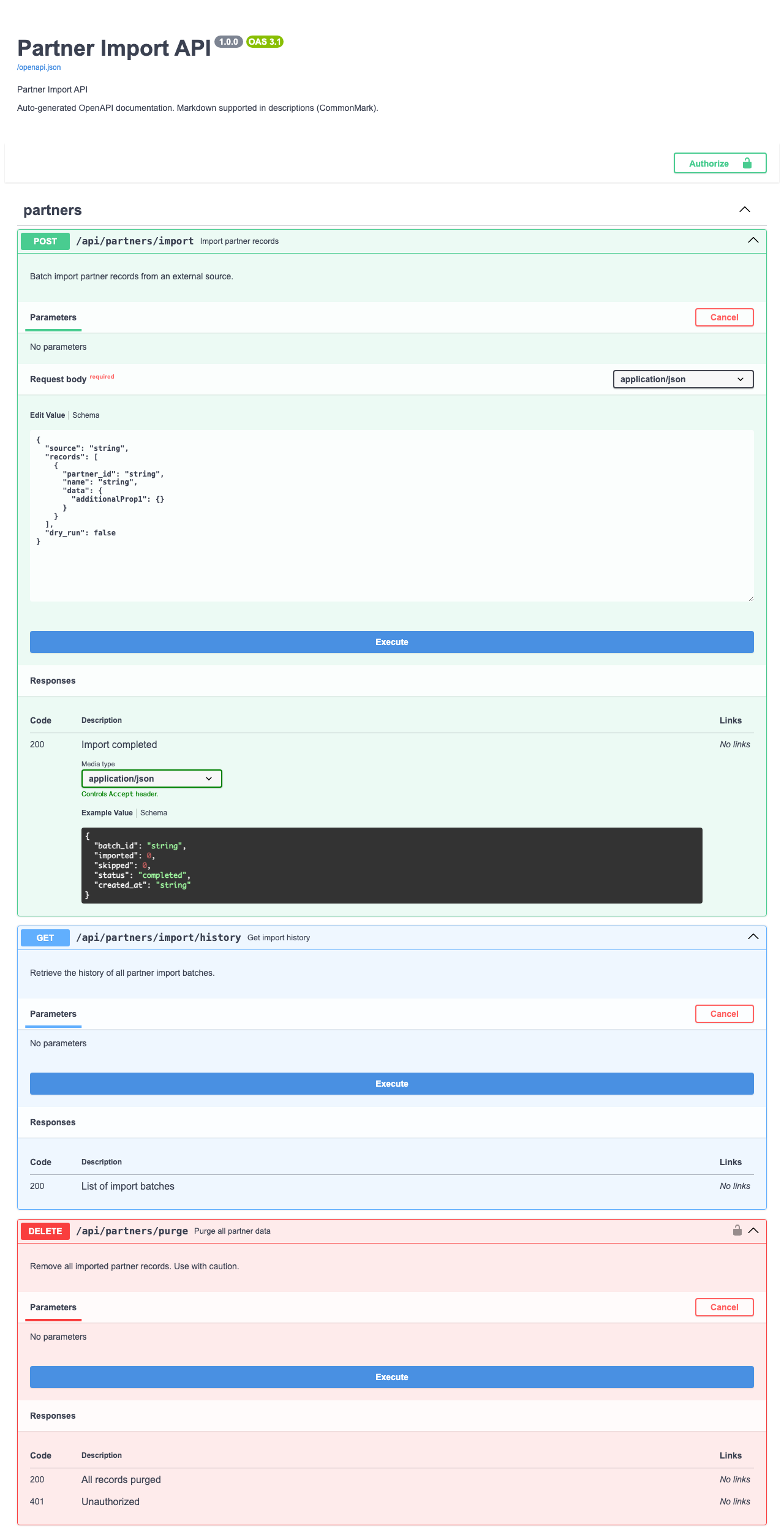
See Partner Import Bridge Example for a complete walkthrough.
Import path migration
The internal module previously named azure_functions_openapi.openapi was
renamed to azure_functions_openapi.spec to remove a naming conflict with the
public @openapi decorator. The old module path remains as a deprecation shim
that emits DeprecationWarning and will be removed in a future release.
Update any imports as follows:
Deprecated (still works, emits DeprecationWarning):
Canonical internal path:
Recommended public API (preferred for application code):
The root package re-exports get_openapi_json, get_openapi_yaml,
generate_openapi_spec, OPENAPI_VERSION_3_0, OPENAPI_VERSION_3_1,
openapi, and render_swagger_ui, so most user code can import everything
directly from azure_functions_openapi without referencing internal
submodules.
Next steps
- Deep-dive decorator options: Configuration
- Auto-generated signatures and docstrings: API Reference
- Generate specs in CI/CD: CLI