Trigger and Binding Best Practices
Trigger and binding choices directly determine execution safety in Azure Functions. The goal is not to use the most feature-rich trigger, but to choose the trigger model whose delivery semantics, scaling behavior, and failure handling match your workload.
For trigger mechanics and extension details, see Platform: Triggers and Bindings.
flowchart TD
    E[Event source] --> T[Trigger listener]
    T --> SC[Scale controller signal]
    SC --> I[Instance allocation]
    I --> H[Functions host + language worker]
    H --> F[Function execution]
    F --> B["Input/Output bindings"]
    B --> D[Downstream service]
Why This Matters
| Use case | Preferred trigger | Why | Watch-outs |
|---|---|---|---|
| Public API endpoint | HTTP | Synchronous request-response path | Auth level, CORS, rate limiting, cold start impact |
| Deferred background jobs | Queue (Storage Queue or Service Bus) | Decouples response latency from processing | Poison handling, visibility timeout, idempotency |
| Scheduled batch operations | Timer | Deterministic schedule execution | CRON drift assumptions, timezone consistency |
| File ingestion pipeline | Blob trigger (plan-dependent source) | Direct storage-driven processing | On Flex, use Event Grid source |
| Integration event fan-out | Event Grid | Reactive and lightweight routing | Event schema/version handling |
| Enterprise messaging workflows | Service Bus | DLQ support, richer broker semantics | Lock duration, max delivery count, throughput tuning |
Trigger-first design
Choose trigger based on delivery semantics first, then optimize language/runtime implementation details.
Portal Walkthrough
This section shows the Function App Overview blade for a live Function App (Consumption Y1, Korea Central). PII is masked.
Functions List (Overview Blade)
[Observed] The Overview blade's Functions tab lists all deployed functions with their Trigger type and Status. Two functions are shown: health (HTTP trigger, Enabled) and hello (HTTP trigger, Enabled). The Monitor column provides an "Invocations and more" link to Application Insights:
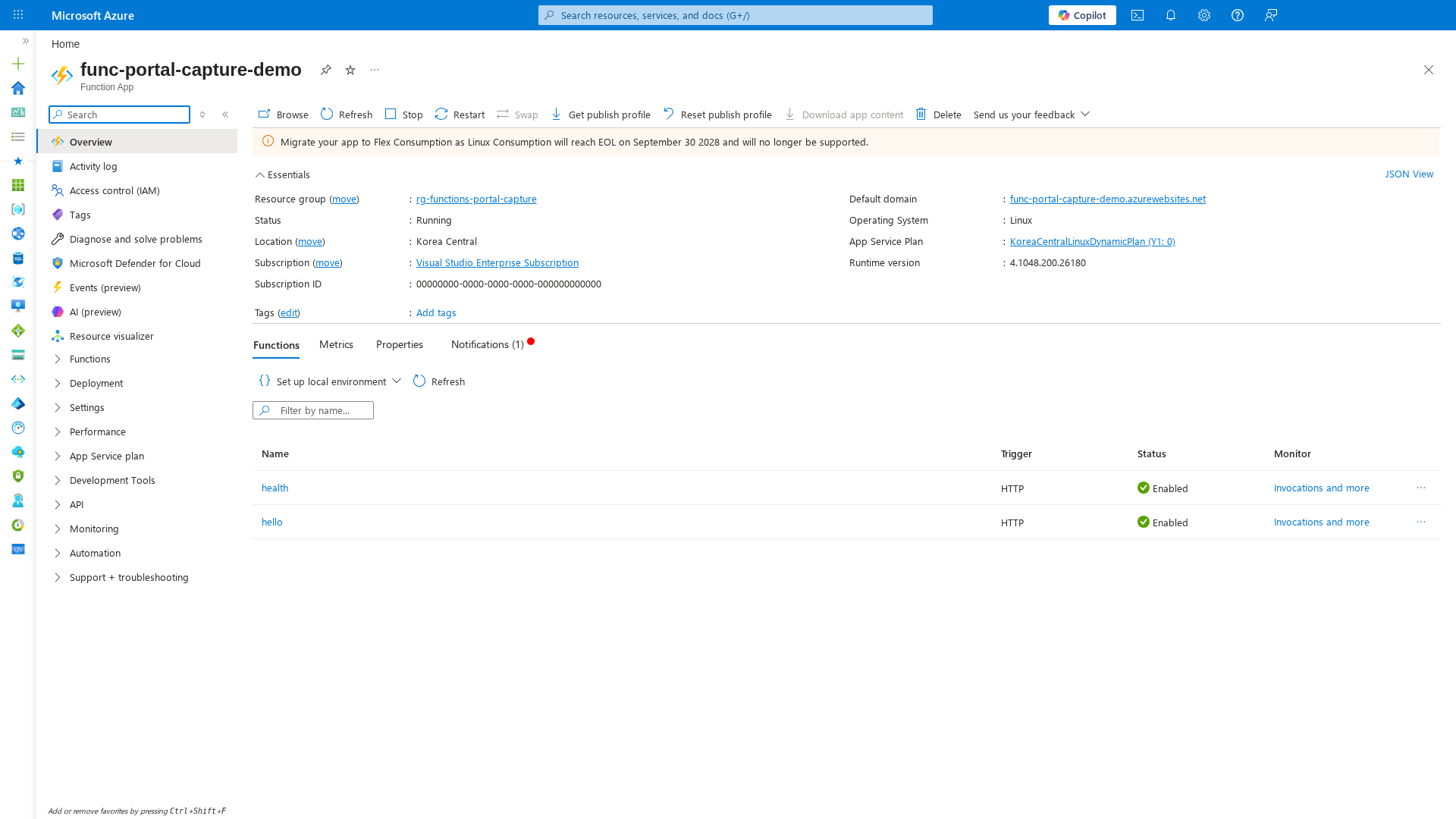
[Inferred] The trigger type column helps verify the correct trigger is bound to each function. Use this view to confirm function status after deployment. The "Invocations and more" link leads directly to per-function monitoring in Application Insights — use it to verify trigger execution rates and error patterns after configuration changes.
Recommended Practices
Plan-trigger compatibility guidance
This matrix is operational guidance, not a hard capability list.
| Trigger | Consumption (Y1) | Flex Consumption (FC1) | Premium (EP) | Dedicated |
|---|---|---|---|---|
| HTTP | Good for moderate, bursty API traffic | Good with optional always-ready | Best for strict latency SLO | Good for fixed-capacity web/API estates |
| Queue | Strong default | Strong default (high burst scale) | Strong default | Good if capacity pre-provisioned |
| Service Bus | Good | Good | Strong for enterprise integration | Good with autoscale rules |
| Timer | Good | Good | Good | Good |
| Blob | Polling model supported | Use Event Grid-backed blob trigger source | Good | Good |
| Event Grid | Good | Good | Good | Good |
Flex blob trigger requirement
On Flex Consumption, use Event Grid source for blob-triggered flows. Standard polling blob trigger mode is not supported.
Binding configuration best practices
Prefer identity-based connections when supported
Use managed identity over raw connection strings to reduce secret sprawl and rotation risk.
| Pattern | Recommended when | Operational impact |
|---|---|---|
| Identity-based binding configuration | Target service supports Entra ID and RBAC | Better secret hygiene, clearer permission model |
| Connection string setting | Legacy integration or unsupported identity path | Faster setup, but higher secret rotation burden |
Storage dependency
Function host startup and some triggers depend on host storage configuration. Treat storage access as a platform dependency, not only an application dependency.
Keep binding contracts explicit
- Use stable payload schemas and document expected fields.
- Avoid oversized messages that silently stress memory and retry behavior.
- Keep output bindings idempotent where downstream operations can be repeated.
HTTP trigger operational defaults
Authentication level selection
| Auth level | Use when | Avoid when |
|---|---|---|
anonymous | Endpoint is protected by upstream gateway auth | Direct internet exposure without compensating controls |
function | Service-to-service invocation with key control | Human-facing identity-based scenarios |
admin | Rare operational endpoints only | General API usage |
CORS and rate safety
- Restrict allowed origins to known frontends.
- Avoid wildcard CORS in production APIs.
- Apply throttling/rate limiting at API Management, Front Door, or Application Gateway layer.
az functionapp cors add \
  --resource-group "$RG" \
  --name "$APP_NAME" \
  --allowed-origins "https://portal.contoso.example"
Queue trigger best practices
Queue-trigger workloads are operationally safe only when retry and poison behavior are explicit.
Recommended controls
- Tune queue batch size to balance throughput and downstream pressure.
- Set visibility timeout long enough for worst-case processing + retry buffer.
- Cap retry count and route failures to poison/dead-letter processing.
- Use idempotency keys to tolerate duplicate delivery.
{
  "version": "2.0",
  "extensions": {
    "queues": {
      "batchSize": 16,
      "newBatchThreshold": 8,
      "maxDequeueCount": 5,
      "visibilityTimeout": "00:05:00"
    }
  }
}
Poison queue is mandatory telemetry
Never discard poison events silently. Alert on poison queue growth and define replay ownership.
Blob trigger design: polling vs Event Grid
| Scenario | Recommended model |
|---|---|
| Consumption/Premium/Dedicated with conventional blob ingestion | Polling blob trigger can be acceptable |
| Flex Consumption workload | Use Event Grid-backed blob trigger source |
| Near-real-time reaction with explicit event contracts | Event Grid-first model |
Operationally, Event Grid models provide clearer event-flow visibility and reduce hidden polling assumptions.
Timer trigger best practices
- Keep CRON expressions explicit and peer-reviewed.
- Align timezone assumptions with UTC-first operations unless strong business need requires local time.
- Treat timer handlers as singleton-intent workloads and enforce idempotency for reruns.
- Ensure scheduled jobs can overlap safely if a previous run exceeds schedule interval.
Common Mistakes / Anti-Patterns
| Mistake | Impact | Safer pattern |
|---|---|---|
| Using HTTP trigger for heavy async processing | Client latency and timeout failures | HTTP ingest + queue output + async processor |
| Missing retry and poison strategy on queue/service bus | Infinite failures or silent drops | Define retry bounds + dead-letter/poison path |
| Assuming blob trigger behaves identically across plans | Missed events on incompatible setup | Validate plan-specific blob trigger model |
| Over-permissive HTTP auth + broad CORS | Exposure risk | Layered auth with scoped origins |
| Treating bindings as guaranteed exactly-once delivery | Duplicate side effects | Idempotent handlers and dedup controls |
Reliability alignment
Pair this guidance with Platform: Reliability and Best Practices: Reliability for idempotency patterns, retry boundaries, and poison-message workflows.
Validation Checklist
Timer checklist
| Check | Why |
|---|---|
| CRON expression validated in test environment | Prevents accidental high-frequency execution |
| Long-running timer job split into chunks | Reduces single-run failure impact |
| Rerun-safe logic implemented | Handles host restarts and duplicate execution windows |
See Also
- Platform: Triggers and Bindings
- Platform: Reliability
- Platform: Scaling
- Operations: Retries and Poison Handling