VNet Integration
Enable VNet Integration so your App Service app can reach private backend services through controlled outbound networking.
Prerequisites
- App Service Plan tier that supports VNet Integration
- Existing virtual network and empty delegated subnet for App Service
- Permissions to configure networking resources (VNet, NSG, private endpoints)
Main Content
Networking pattern
flowchart TD
    A[App Service] --> B[VNet Integration Subnet]
    B --> C[Private Endpoint: SQL]
    B --> D[Private Endpoint: Key Vault]
    B --> E[Private Endpoint: Redis]
    B --> F[NSG + UDR Controls]
Step 1: create delegated subnet
az network vnet subnet create \
  --resource-group "$RG" \
  --vnet-name "vnet-appservice" \
  --name "snet-appservice-integration" \
  --address-prefixes "10.10.1.0/24" \
  --delegations "Microsoft.Web/serverFarms" \
  --output json
Step 2: connect web app to subnet
az webapp vnet-integration add \
  --resource-group "$RG" \
  --name "$APP_NAME" \
  --vnet "vnet-appservice" \
  --subnet "snet-appservice-integration" \
  --output json
Step 3: route all outbound traffic through VNet (optional)
az webapp config appsettings set \
  --resource-group "$RG" \
  --name "$APP_NAME" \
  --settings WEBSITE_VNET_ROUTE_ALL=1 \
  --output json
This enforces stricter egress control but requires proper route and DNS design.
Step 4: NSG baseline rules
Apply NSG to integration subnet with least privilege:
- allow required backend ports (for example 1433, 6380, 443)
- deny broad outbound destinations where possible
- log NSG flow events for troubleshooting
Step 5: private endpoints for backend services
Create private endpoints for SQL/Key Vault/Redis in dedicated subnets, then link private DNS zones so app can resolve private FQDNs.
Example private DNS zones:
privatelink.database.windows.netprivatelink.vaultcore.azure.netprivatelink.redis.cache.windows.net
Step 6: verify DNS from app runtime
Use Kudu SSH/console and run name resolution checks to confirm private IP resolution for backend hostnames.
Inbound vs outbound
VNet Integration controls outbound from app to private services. It does not place App Service itself inside your VNet for inbound traffic.
Bicep integration concept
When codifying networking, split into modules:
- vnet/subnet module
- private endpoint module per backend
- appservice integration module
Keep app and network lifecycle loosely coupled for safer operations.
App setting patterns for private dependencies
az webapp config appsettings set \
  --resource-group "$RG" \
  --name "$APP_NAME" \
  --settings \
    SPRING_DATASOURCE_URL="jdbc:sqlserver://<sql-private-fqdn>:1433;database=<db>;encrypt=true;hostNameInCertificate=*.database.windows.net;authentication=ActiveDirectoryManagedIdentity" \
    SPRING_DATA_REDIS_HOST="<redis-private-fqdn>" \
  --output json
Plan subnet capacity
Integration subnet size impacts scaling headroom. Start with a subnet range that supports expected instance growth.
Platform architecture
For platform architecture details, see Platform: How App Service Works.
Verification
az webapp vnet-integration listshows configured integration- Backend FQDN resolves to private IPs from app runtime tools
- App successfully accesses private SQL/Key Vault/Redis endpoints
Troubleshooting
App cannot reach private backend
Validate NSG rules, private endpoint approval state, and private DNS zone links.
DNS resolves public endpoint instead of private
Check VNet DNS settings and private DNS zone association to the integration VNet.
Connectivity broke after enabling route-all
Review route table (UDR) and ensure required Azure service endpoints are reachable through your forced egress path.
Run It in the Portal
Portal view: Networking blade (Virtual network integration not yet configured)
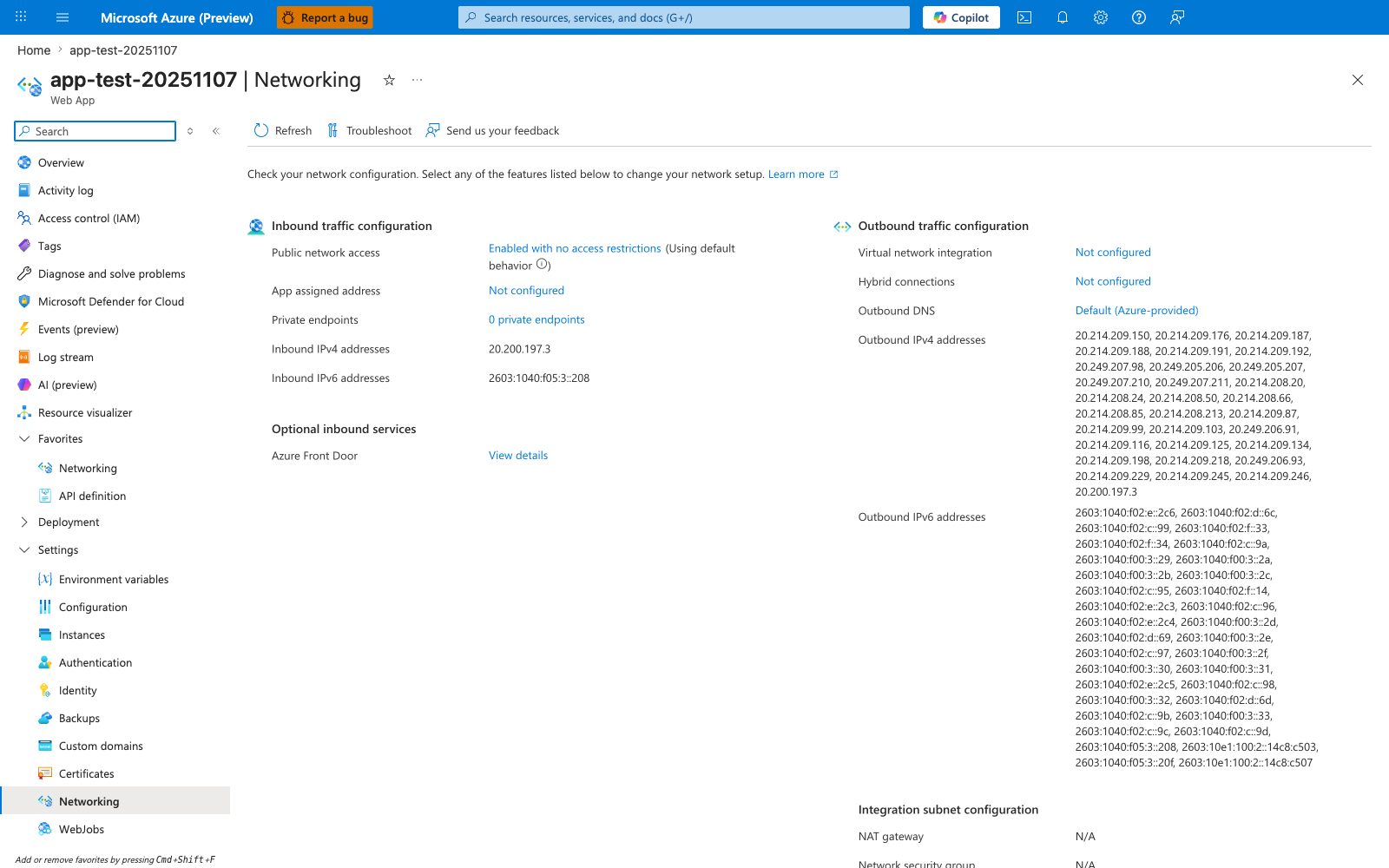
The Networking blade is the Portal surface where this recipe's outbound VNet connection becomes visible. In the pre-recipe state shown here, Virtual network integration: Not configured is the key row; after az webapp vnet-integration add, this is the row to revisit to confirm the Spring Boot app is attached to the delegated subnet. The Inbound traffic configuration card remains separate, which matches the recipe's point that VNet integration changes outbound connectivity rather than inbound exposure on its own.