07. Custom Domain & SSL
Map a custom domain to your Windows App Service app, validate ownership, and secure traffic with a managed TLS certificate.
Infrastructure Context
Service: App Service (Windows, Standard S1) | Network: VNet integrated | VNet: ✅
This tutorial assumes a production-ready App Service deployment with VNet integration, private endpoints for backend services, and managed identity for authentication.
flowchart TD
    INET[Internet] -->|HTTPS| WA["Web App\nApp Service S1\nWindows .NET 8"]

    subgraph VNET["VNet 10.0.0.0/16"]
        subgraph INT_SUB["Integration Subnet 10.0.1.0/24\nDelegation: Microsoft.Web/serverFarms"]
            WA
        end
        subgraph PE_SUB["Private Endpoint Subnet 10.0.2.0/24"]
            PE_KV[PE: Key Vault]
            PE_SQL[PE: Azure SQL]
            PE_ST[PE: Storage]
        end
    end

    PE_KV --> KV[Key Vault]
    PE_SQL --> SQL[Azure SQL]
    PE_ST --> ST[Storage Account]

    subgraph DNS[Private DNS Zones]
        DNS_KV[privatelink.vaultcore.azure.net]
        DNS_SQL[privatelink.database.windows.net]
        DNS_ST[privatelink.blob.core.windows.net]
    end

    PE_KV -.-> DNS_KV
    PE_SQL -.-> DNS_SQL
    PE_ST -.-> DNS_ST

    WA -.->|System-Assigned MI| ENTRA[Microsoft Entra ID]
    WA --> AI[Application Insights]

    style WA fill:#0078d4,color:#fff
    style VNET fill:#E8F5E9,stroke:#4CAF50
    style DNS fill:#E3F2FD
flowchart TD
A[Choose hostname strategy] --> B[Add DNS records]
B --> C[Add hostname in App Service]
C --> D[Create managed certificate]
D --> E[Bind certificate to hostname]
E --> F[Verify HTTPS access]Prerequisites
- Tutorial 06. CI/CD completed
- Existing public domain you can manage in DNS
- Production app already serving traffic on
*.azurewebsites.net
What you'll learn
- Add and verify a custom hostname
- Configure required DNS records safely
- Bind an App Service managed certificate
- Automate domain checks in Azure DevOps release flow
Main content
1) Decide domain strategy
Common patterns:
api.contoso.com(API only)www.contoso.comandapi.contoso.comsplit by app- Temporary cutover hostname such as
api-next.contoso.com
2) Retrieve default app hostname
az webapp show \
  --resource-group "$RESOURCE_GROUP_NAME" \
  --name "$WEB_APP_NAME" \
  --query "defaultHostName" \
  --output tsv
| Command/Code | Purpose |
|---|---|
az webapp show --resource-group "$RESOURCE_GROUP_NAME" --name "$WEB_APP_NAME" --query "defaultHostName" --output tsv | Returns the default Azure-hosted hostname for the web app. |
3) Add DNS records
For subdomain (api.contoso.com), add CNAME:
- Name:
api - Value:
<web-app-name>.azurewebsites.net
For apex/root domain, use A/ALIAS approach recommended by your DNS provider.
4) Add custom hostname in App Service
az webapp config hostname add \
  --resource-group "$RESOURCE_GROUP_NAME" \
  --webapp-name "$WEB_APP_NAME" \
  --hostname "api.contoso.com" \
  --output json
| Command/Code | Purpose |
|---|---|
az webapp config hostname add --resource-group "$RESOURCE_GROUP_NAME" --webapp-name "$WEB_APP_NAME" --hostname "api.contoso.com" --output json | Adds the custom hostname binding to the App Service app. |
If validation fails, wait for DNS propagation and retry.
5) Create managed certificate
az webapp config ssl create \
  --resource-group "$RESOURCE_GROUP_NAME" \
  --name "$WEB_APP_NAME" \
  --hostname "api.contoso.com" \
  --output json
Preview Command
az webapp config ssl create is currently in Preview. Not all hostname configurations are eligible for managed certificates. See App Service TLS overview for eligibility requirements. The Azure Portal provides an alternative path for managed certificate creation.
| Command/Code | Purpose |
|---|---|
az webapp config ssl create --resource-group "$RESOURCE_GROUP_NAME" --name "$WEB_APP_NAME" --hostname "api.contoso.com" --output json | Requests an App Service managed certificate for the custom domain. |
6) Bind certificate to hostname
az webapp config ssl bind \
  --resource-group "$RESOURCE_GROUP_NAME" \
  --name "$WEB_APP_NAME" \
  --certificate-thumbprint "<thumbprint>" \
  --ssl-type SNI \
  --output json
| Command/Code | Purpose |
|---|---|
az webapp config ssl bind --resource-group "$RESOURCE_GROUP_NAME" --name "$WEB_APP_NAME" --certificate-thumbprint "<thumbprint>" --ssl-type SNI --output json | Binds the issued certificate to the hostname using SNI-based TLS. |
7) Enforce HTTPS-only
az webapp update \
  --resource-group "$RESOURCE_GROUP_NAME" \
  --name "$WEB_APP_NAME" \
  --https-only true \
  --output json
| Command/Code | Purpose |
|---|---|
az webapp update --resource-group "$RESOURCE_GROUP_NAME" --name "$WEB_APP_NAME" --https-only true --output json | Forces the app to accept only HTTPS traffic. |
8) Keep app behavior host-agnostic
app.MapGet("/info", (HttpContext context) => Results.Ok(new
{
    host = context.Request.Host.Value,
    scheme = context.Request.Scheme,
    environment = app.Environment.EnvironmentName
}));
| Command/Code | Purpose |
|---|---|
app.MapGet("/info", ...) | Adds a lightweight endpoint for checking host and scheme values at runtime. |
context.Request.Host.Value | Returns the hostname used by the incoming request. |
context.Request.Scheme | Returns whether the request arrived over HTTP or HTTPS. |
app.Environment.EnvironmentName | Returns the current ASP.NET Core environment name. |
This helps verify traffic is actually reaching the expected domain over HTTPS.
9) Azure DevOps validation snippet
- task: AzureCLI@2
  displayName: Validate custom domain health
  inputs:
    azureSubscription: $(azureSubscription)
    scriptType: bash
    scriptLocation: inlineScript
    inlineScript: |
      curl --fail --silent "https://api.contoso.com/health"
Certificate issuance timing
Managed certificate provisioning is not instant. Do not schedule cutover until certificate state is ready and HTTPS probe succeeds.
Verification
| Command/Code | Purpose |
|---|---|
curl --include "https://api.contoso.com/health" | Verifies HTTPS connectivity and the health endpoint response. |
curl --silent "https://api.contoso.com/info" | Checks that the app reports the expected custom host and scheme. |
Validate:
- TLS handshake succeeds with valid certificate chain
- HTTP redirects to HTTPS if enabled
- App responds from custom hostname with expected payload
Troubleshooting
Domain verification fails
- Confirm CNAME/A record points to correct App Service endpoint
- Verify no conflicting DNS records exist
- Allow propagation time before retrying
SSL bind fails with thumbprint issue
List certificates and use exact thumbprint:
| Command/Code | Purpose |
|---|---|
az webapp config ssl list --resource-group "$RESOURCE_GROUP_NAME" --output table | Lists available certificates so you can confirm the correct thumbprint. |
Intermittent 404 after domain cutover
Check hostname binding list and ensure the custom host is attached to the right app/slot.
Run It in the Portal
Portal view: Custom domains blade (post-binding verification)
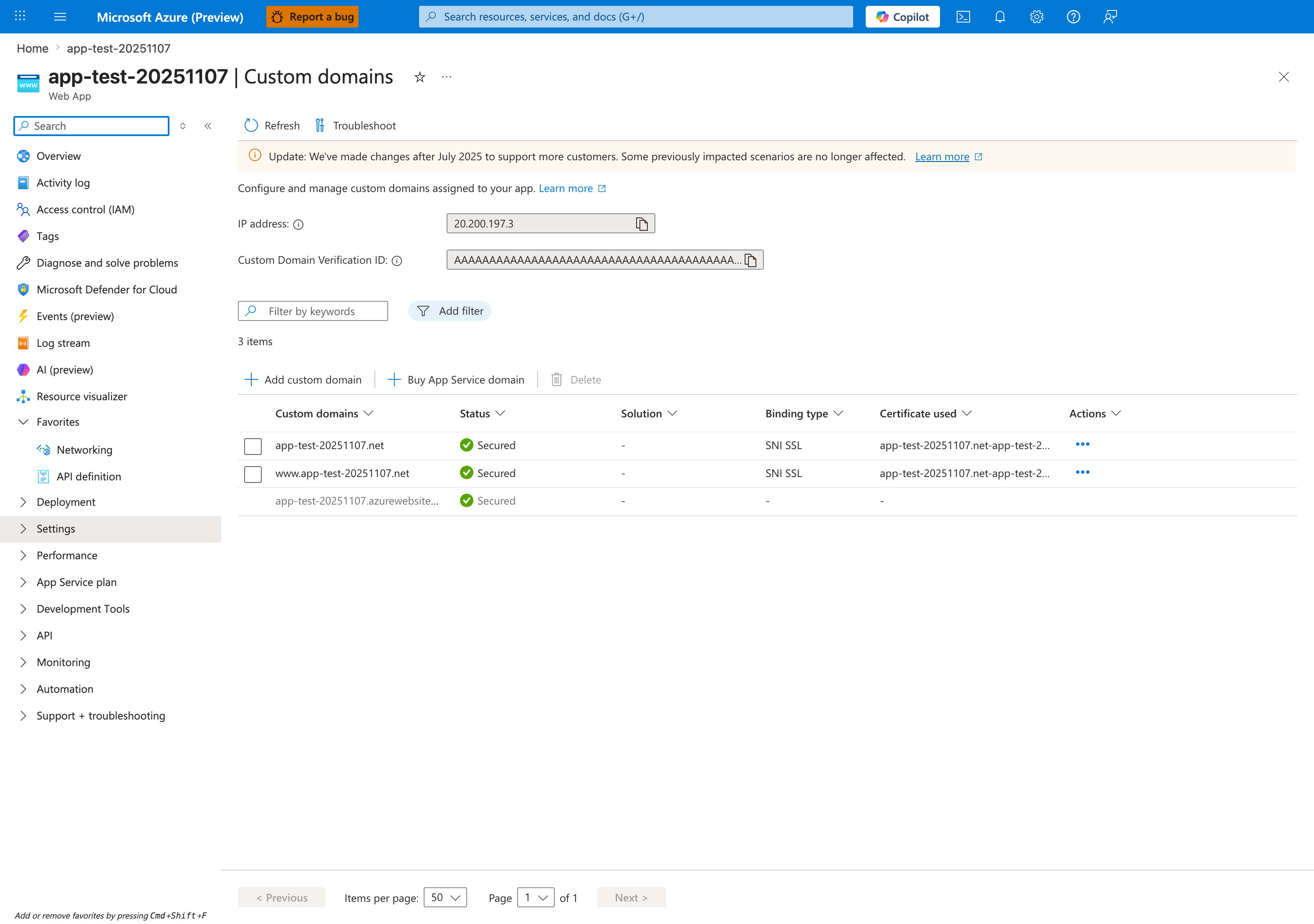
The Custom domains blade is the Portal verification surface for the az webapp config hostname add and az webapp config ssl bind steps in this tutorial. After DNS validation and certificate binding for the .NET app, the custom-hostname rows should show Status: Secured, Binding type: SNI SSL, and a populated Certificate used value, which is the end state visible for app-test-20251107.net and www.app-test-20251107.net in this screenshot. The IP address field at the top is the value you compare against the apex-domain A record during setup, and Add custom domain is the visible Portal entry point for the same hostname-binding flow. Use this blade after the CLI steps to confirm the hostname rows, binding type, and certificate columns all reflect the expected custom-domain state.
See Also
- 06. CI/CD
- Recipes: Deployment Slots Validation
- For platform details, see Azure App Service Guide