VNet Integration
Enable VNet integration for an ASP.NET Core 8 app so outbound calls to SQL, Redis, and Key Vault stay on private network paths.
flowchart TD
    A[ASP.NET Core app on App Service] --> B[VNet integration subnet]
    B --> C[Private Endpoint SQL]
    B --> D[Private Endpoint Key Vault]
    B --> E[Private Endpoint Redis]
B --> F[NSG and UDR controls]Prerequisites
- App Service Plan tier that supports VNet integration
- Existing virtual network and delegated subnet for App Service
- Permissions to configure VNet, NSG, private endpoints, and DNS
- ASP.NET Core 8 app running on Windows App Service (do not use
--is-linuxfor .NET setup)
Main Content
1) Create delegated subnet for integration
az network vnet subnet create \
  --resource-group "$RG" \
  --vnet-name "vnet-appservice" \
  --name "snet-appservice-integration" \
  --address-prefixes "10.10.1.0/24" \
  --delegations "Microsoft.Web/serverFarms" \
  --output json
2) Attach App Service to subnet
az webapp vnet-integration add \
  --resource-group "$RG" \
  --name "$APP_NAME" \
  --vnet "vnet-appservice" \
  --subnet "snet-appservice-integration" \
  --output json
3) Enable route-all for controlled outbound (optional)
az webapp config appsettings set \
  --resource-group "$RG" \
  --name "$APP_NAME" \
  --settings WEBSITE_VNET_ROUTE_ALL=1 \
  --output json
4) Apply NSG policy baseline
Allow only required outbound traffic from integration subnet (for example ports 1433, 6380, 443), and monitor NSG flow logs.
5) Create private endpoints and link private DNS zones
Deploy private endpoints for SQL, Key Vault, and Redis in dedicated subnet(s), then link these zones to the app VNet:
privatelink.database.windows.netprivatelink.vaultcore.azure.netprivatelink.redis.cache.windows.net
6) Configure dependency settings in appsettings.json
{
  "ConnectionStrings": {
    "SqlServer": "Server=tcp:<sql-private-fqdn>,1433;Database=<db-name>;Encrypt=True;TrustServerCertificate=False;"
  },
  "Redis": {
    "Host": "<redis-private-fqdn>",
    "Port": 6380,
    "Ssl": true
  },
  "KeyVault": {
    "Uri": "https://<kv-name>.vault.azure.net/"
  }
}
7) Use DefaultAzureCredential, Microsoft.Data.SqlClient, and StackExchange.Redis
using Azure.Identity;
using Microsoft.Data.SqlClient;
using StackExchange.Redis;

var credential = new DefaultAzureCredential();
var sqlToken = (await credential.GetTokenAsync(
    new Azure.Core.TokenRequestContext(new[] { "https://database.windows.net/.default" })
)).Token;

var connectionString = builder.Configuration.GetConnectionString("SqlServer");
using var sqlConnection = new SqlConnection(connectionString)
{
    AccessToken = sqlToken
};
await sqlConnection.OpenAsync();

var redisHost = builder.Configuration["Redis:Host"];
var redisPort = builder.Configuration["Redis:Port"];
var redis = await ConnectionMultiplexer.ConnectAsync($"{redisHost}:{redisPort},ssl=True,abortConnect=False");
8) Add CI validation checks for integration and endpoints
- name: Validate VNet integration and private endpoints
  run: |
    az webapp vnet-integration list \
      --resource-group "$RG" \
      --name "$APP_NAME" \
      --output table
    az network private-endpoint list \
      --resource-group "$RG" \
      --output table
Inbound versus outbound
VNet integration governs outbound connectivity from App Service. Inbound private access requires separate App Service private endpoint configuration.
Verification
az webapp vnet-integration listreports expected subnet integration.- SQL, Redis, and Key Vault names resolve to private IPs in app diagnostics.
- ASP.NET Core app can connect without public network dependency.
Troubleshooting
SQL authentication or connection failure
- Confirm system-assigned managed identity is enabled.
- Verify Microsoft Entra SQL permissions for the app identity.
- Validate NSG/UDR path to SQL private endpoint.
Redis connection timeout
- Confirm private DNS resolution for Redis hostname.
- Validate outbound allowance on TCP 6380.
Connectivity regression after route-all
- Inspect route table and next hop configuration.
- Confirm required Azure control plane dependencies remain reachable.
Run It in the Portal
Portal view: Networking blade (Virtual network integration not yet configured)
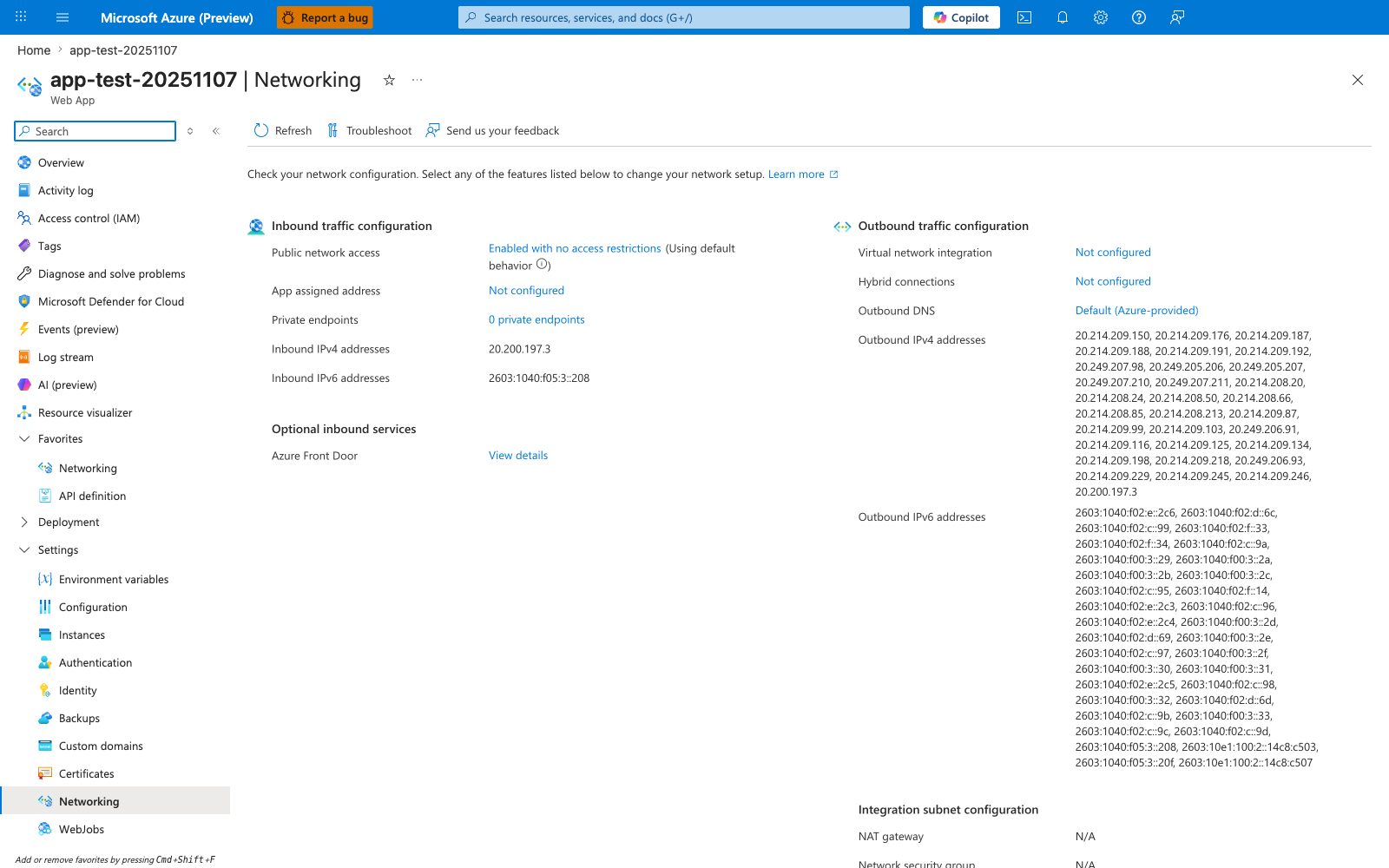
The Networking blade is the Portal surface where this recipe's outbound VNet connection becomes visible for the ASP.NET Core app. In the pre-recipe state shown here, Virtual network integration: Not configured is the key row; after az webapp vnet-integration add, this is the row to revisit to confirm the app is attached to the delegated subnet, which is the precondition for the recipe's Microsoft.Data.SqlClient and StackExchange.Redis connections to reach backend services over the private network. The Inbound traffic configuration card remains separate, which matches the recipe's point that VNet integration changes outbound connectivity rather than inbound exposure on its own.